
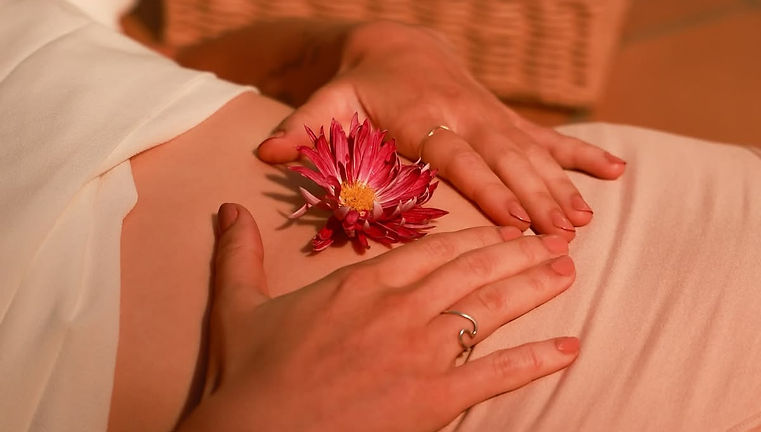
There is a wisdom in the body that we often forget.
We are not just muscles, bones, and skin.
Inside us, organs pulse, move, breathe.
And when something in that movement changes, your body asks for help.
Visceral massage is the art of listening to that language.
Ancient Origins, Modern Discipline
The roots of visceral work run deep.
Ancient traditions—from Ayurveda to Traditional Chinese Medicine—recognised the belly as the center of being.
In modern times, this wisdom was refined through the work of Jean-Pierre Barral, an internationally renowned French osteopath.
Barral developed Visceral Manipulation, a structured approach that explores the mobility and motility of internal organs, and how their tensions can influence the entire body.
This is not about strong pressure or invasive techniques.
It is a refined, precise, and deeply respectful touch.
Organs Are Not Static
Every organ has its own rhythm.
The diaphragm rises and falls with each breath.
The intestines contract and release.
The liver, kidneys, and uterus each have their own internal balance.
When this movement is free, the body functions with ease.
But when restrictions form—due to inflammation, surgical scars, chronic stress, or trauma—that freedom diminishes.
The body adapts.
And often, symptoms appear somewhere else.
Referred Pain: When the Source Is Not Where It Seems
The body does not always express pain at its source.
Internal organs share neurological pathways with muscles and joints.
This means that visceral tension may show up as:
Lower back pain — often linked to intestinal, uterine, or kidney restrictions
Digestive issues — often linked to phrenic and vagus nerves, and diaphragmatic tension
Headaches — sometimes connected to diaphragm and neck tension
Pelvic or menstrual pain — related to uterine, ovarian, or scar tissue restrictions
Understanding this map is essential.
Because treating only the symptom rarely creates lasting change.
Conditions That Visceral Massage Can Support
This work supports the body in a wide range of conditions.
Endometriosis and scar tissue — improving mobility and reducing chronic pain
Menstrual pain — supporting a more natural and less restricted cycle
Digestive discomfort — stimulating the natural movement of the gut
Diaphragmatic tension — restoring breath and nervous system regulation
Headaches of visceral origin
Lower back pain — when the origin is not purely structural
The Diaphragm: The Great Connector
The diaphragm is more than a breathing muscle.
It is a central meeting point within the body.
Through it pass key structures such as the phrenic nerve and the vagus nerve—both essential in regulating internal function.
A free diaphragm supports:
deeper, calmer breathing
activation of the parasympathetic nervous system
improved digestion
a more grounded and present state
When it becomes restricted, these functions can be affected.
Visceral work helps restore its natural movement—and with it, the body begins to breathe more fully again.
The Gut-Brain Connection
The gut is often called the “second brain”—and for good reason.
The gut-brain axis is a real, bidirectional communication system involving the vagus nerve, the microbiome, and millions of neurons in the digestive system.
Emotions travel to the gut.
And what happens in the gut travels back to the brain.
Visceral massage works directly on this connection—supporting both physical and emotional balance.
Organs Speak of Who We Are
The body holds what we experience.
Anger may be felt in the liver.
Anxiety in the stomach.
Sadness in the chest.
Emotions are not separate from the body—they live within it.
Organs reflect our internal world, both in ease and in tension.
Sometimes, a physical restriction carries something unprocessed.
Visceral work does not force change.
But it creates space—for movement, release, and awareness.
A Gentle, Global, and Respectful Approach
This is not a symptomatic treatment.
Visceral massage is a global approach that considers the whole body.
It listens to patterns.
It respects timing.
It supports the body rather than trying to fix it.
The touch is gentle.
The pace is slow.
The work is precise.
Who This Work Is For
At Womb to World, this work is offered as a personalised treatment.
Each session is tailored to your body, your history, and your needs.
It may be particularly supportive for:
women with chronic menstrual pain or endometriosis
post-surgical recovery and internal scarring
those experiencing unexplained tension or discomfort
anyone seeking a deeper, more integrated approach to health
This is not just a massage.
It is a way of reconnecting with your body.
And you don’t have to do it alone.
References
Barral, J.P., & Mercier, P. (2005). Visceral Manipulation. Eastland Press.
Barral, J.P. (2007). Visceral Manipulation II. Eastland Press.
Mayer, E.A. (2011). Gut feelings: the emerging biology of gut–brain communication. Nature Reviews Neuroscience, 12(8), 453–466
Stecco, C. (2015). Functional Atlas of the Human Fascial System. Elsevier.
Porges, S.W. (2011). The Polyvagal Theory. W.W. Norton & Company.